About LaneHelp
Local information should be easier to find, trust, and use.
LaneHelp turns scattered Lane County information into practical pages, tools, and next steps.
Current public scope
A working county platform, counted in public.
891
Public resources
292
Housing options
31
Communities
68
Structured fields
Stats report generated Oct 16, 2026. Counts link to their definitions and limitations instead of pretending a big number explains itself.
More than a directory
A public page is the last step, not the whole system.
LaneHelp normalizes inconsistent source information, preserves where facts came from, tracks freshness and review, and structures the details people actually need to reach a service.
Low-barrier emergency shelter with up to 14 days of shelter plus meals, showers, laundry, clothing, storage, and staff support.
8 data groups
Identity, contact, access, eligibility, classification, geography, provenance, and presentation.
1M+ tracked lines
1,003,811 code and structured-data lines in the tracked working tree audit.
441,683 TS/TSX lines
Application-source code is reported separately from JSON and other structured data.
Review before trust
Automated checks can propose; accountable review controls what becomes public.
What people can use
Public tools, free to use.
The full public Browse set is here: 23 working destinations for finding help, following local conditions, using county data, printing handoffs, and participating in the community.
Find and use help
What is happening
Organization accounts · available now
If your organization appears in LaneHelp, here is what an account can do.
Claim or request a reviewed organization page, show the connection, and use scoped tools without becoming a LaneHelp administrator.
Public page
Manage public-safe organization details and share one reviewed LaneHelp address.
Team access
Invite teammates so one person is not the only keeper of the organization’s information.
Linked listings
Propose changes to confirmed resources; listing changes stay in review until LaneHelp approves them.
Lanes
Share updates, ask operational questions, tag organizations, and confirm information about your own services.
Shelter status
Confirmed shelter Owners and Admins can publish bed and intake status for their linked shelters.
Data & Insights
Start with a real question.
“Where are transportation and service availability creating access gaps?”
Community Insights is Lane County-specific data. It connects public demographic, housing, health, transportation, and resource-location evidence to questions about local conditions and access.
For LaneHelp-specific data—directory coverage, public activity, traffic, definitions, and platform limits—use LaneHelp Stats.
- Access-gap and resource-coverage studies
- Transportation and service-location context
- Maps, dashboards, reports, and derived datasets
- Privacy-safe aggregate information patterns
- Workforce, HRSN, and referral-path questions where the data supports them
- Data cleanup, normalization, and verification projects
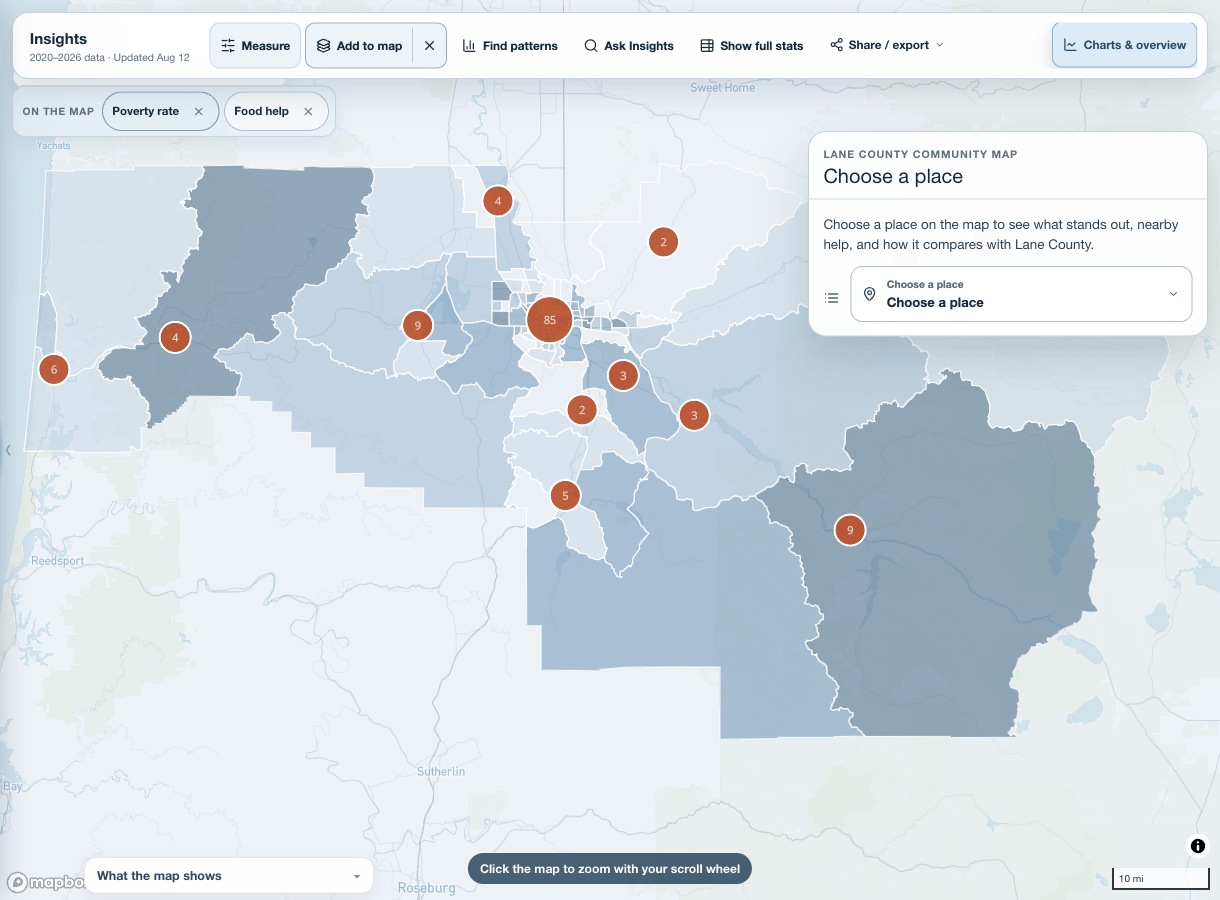
Real Community Insights workspace. Tract estimates and public resource locations support screening and planning; they do not prove service capacity, travel time, funding, or outcomes.
Things LaneHelp can build
We like building things that help.
Sometimes the useful thing is a map. Sometimes it’s an app, website, communication tool, coordination system, dashboard, integration, workflow, internal utility, or something much more specific.
Bring the problem, rough idea, workflow, or gap. LaneHelp can help figure out what would actually be useful.
01
Maps & place-based tools
Interactive maps for service coverage, routing, access, locations, and geographic context.
02
Communication
SMS tools, alerts, updates, handoffs, notification systems, and simpler ways to keep people informed.
03
Apps & websites
Public or internal tools, mobile experiences, focused websites, portals, utilities, and lightweight applications.
04
Coordination
Shared workflows, status tools, handoff systems, operational views, scheduling, and multi-group coordination.
05
Data & analysis
Dashboards, reports, datasets, research, normalization, visualization, APIs, and structured-data work.
06
Something very specific
A purpose-built tool for a local problem that does not fit neatly into an existing category.
Working with LaneHelp
Bring a problem, rough idea, broken workflow, information gap, coordination issue, communication problem, or process that should be easier.
What that might become
Build a map. Improve a handoff. Make an app. Commission a dashboard. Build an integration. Create a clearer public page. Fund a scoped analysis or another useful build.
Supporting LaneHelp
Support can fund infrastructure, tools, and new local solutions.
Grants, sponsorship, project funding, data or technical support, verification work, analysis, integrations, maintenance, introductions, and new tools can all help. Organizations are supporting useful public work—not purchasing access to LaneHelp users.
LaneHelp listings remain free. Payment does not determine search ranking, visibility, verification, or endorsement.
Privacy and boundaries
We share insights, not identities.
LaneHelp does not sell access to users, identities, personal search histories, leads, or individual behavioral profiles.
What funding supports
Infrastructure, structured information, research, analysis, maps, tools, integrations, reports, and verification or maintenance work.
What LaneHelp is not
Not an EHR, HMIS, CRM, clinical record system, case-management platform, or outcome-confirmation system.
Have a question, correction, dataset, project, or idea?
Residents, providers, organizations, agencies, researchers, community groups, and funders can all use the same contact path. A rough idea is enough.